

Country Next: Ben Gallaher
We’re proud to showcase country music’s brightest new stars through our Country Next series. In this installment, we talk to Ben Gallaher.

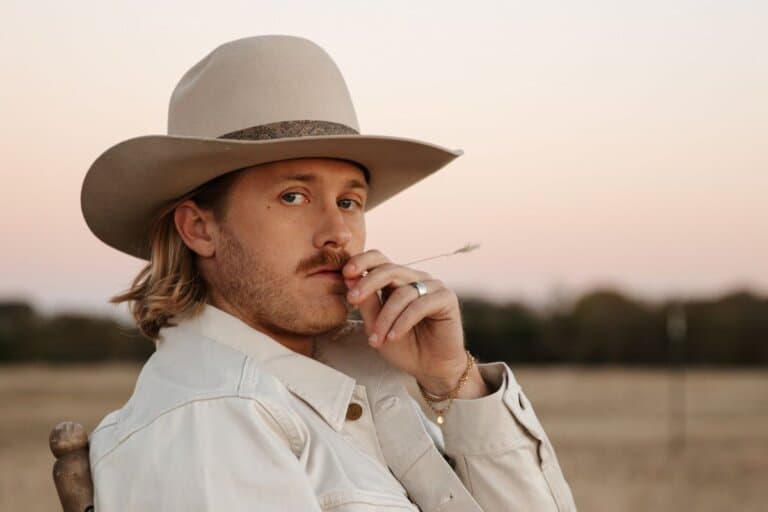
Ben Gallaher; Photo by Jessica Crans
With a strong love for ’90s country and a guitar always in his hand, Ben Gallaher has built a reputation as a triple-threat singer, songwriter, and guitarist. Now, known for creating melodic riffs and standout solos, Gallaher’s skills shine on his sophomore album, Time.
Starting out on the road as a teenager from small-town Pennsylvania, he’s shared stages with legends like Blake Shelton, Lynyrd Skynyrd, and Hank Williams Jr., eventually making his way to Nashville. Along the way, he carved out his own space in modern country-rock built on his unique playing style.

The QHMG/Stone Country Records artist’s love for the instrument can be heard all throughout his new record, which finds him playing every lead guitar part alongside support from some of Nashville’s top session musicians on rhythm guitar. He also serves as a co-writer on five of its 13 songs, allowing him to take a deep dive into his southern storytelling and powerful anthems alongside producers Neil and Patrick Thrasher.
Gallaher’s album features standout tracks like “Bullet,” a cover of Brian Adams’ “Cuts Like a Knife,” and “Stomp.” More notably, the lead track, “I’ll Take You,” is set to impact country radio in early 2026. Originally a slow ballad, Gallaher joined forces with his producers to rework this love song into an energetic, guitar-driven track that’s perfect for radio.
Continue reading to get the inside scoop on the evolution of Ben Gallaher’s career, his new album, and more on this installment of Country Next.
You are considered to be a triple threat as a singer, songwriter and guitarist. So how did your journey with music begin?
I started playing guitar when I was six. It was a total God thing. Nobody in my family played it all. And I grew up on ‘90s country and strictly, I mean, that’s what my folks had playing in the house. And so that’s when I got the bug. But they got me a guitar and at first before six kind of a plastic fake guitar. I would strum along to the radio and they saw something, my folks did, and ended up getting me a kid’s guitar, but a real one. And I took to it. It sounds crazy, but that was that. From then on, it was like I felt like this was what I was supposed to do. I had a couple lessons early on, but then just did my own thing. And being really a student of ‘90s country, I mean Nashville, that’s the place. So since I was a kid, I’ve been doing this and wanting to do it. So that’s a huge blessing too, because I knew that there was never a plan B. This is just what I feel like I’m called to do.
Did singing and songwriting naturally follow?
Yeah, that was early too. I mean, songwriting wasn’t until high school, but singing would be not long after I was starting to strum. I mean, I probably wasn’t singing in key at that young. And then I moved to Nashville at 19 and I didn’t know anybody. I think when an artist writer, when they first move to town, a lot of guys and girls, they try to form their writing circle and the people that they like to co-write with and really dive into that world. And as much as I love co-writing, I was so fixated on being on the road and trying to learn how to work a crowd and build a fan base. So I would rent a van with the band that I had formed before I could buy a van at the time, and we would play any place that would have us play for free. I was so fixated on just getting out there and trying to learn that world, which I hadn’t done before Nashville. I had played in Pennsylvania, just solo acoustic stuff, but I hadn’t been on the road and learning how to do it.
Having opened for some amazing artists and earned a solid reputation with your skills, how does it feel to look back on everything you’ve accomplished on your journey?
I mean, it’s just like to be able to open up for a band like Skynyrd that I did end up growing up on once I got a little older in high school, I got into that Southern rock stuff. But I remember staying side stage after one of the several shows with Skynyrd and I’m watching them play “Sweet Home Alabama” and thinking, man, how many times do you think these guys have played that song? They were probably so sick of it by now, but they made it seem to the crowd like it was the first time because the crowd just paid a lot of money to be there and hotels and babysitters and travel and food and merch and ticket price and I’m thinking like, man, these guys are giving them a show even after all those years of doing it. And I’m like, wow, that’s pretty, I mean, that’s a professional right there, a professional group. But yeah, no, getting a chance to open up for cats like that is awesome because you get exposed to a lot of fans of music, country rock that might not know who you are. So that’s huge.
What does your new album, Time, represent for you at this point in your career right now?
Yeah, Time is the album I’ve always wanted to make, and I feel like every guitar solo, every guitar riff, every song I’ve written, every live show, all in my whole career led me to this album right here. And that’s why I named it Time just because I feel like everything went into making a record that I finally always wanted to make.

Can you share a bit more about the title track and why it was chose it to sum up the entire project?
I love the song “Time,” but naming the album was much bigger than just the song…I feel like everything I’ve done has led me to this album and it covers some time. Like “Stomp” and “Cuts Like A Knife” are two songs that they were out previously, but they were really big points in my career and they never lived on a bigger project. So I felt like I wanted to have those two a part of the full album. But each song kind of also does take me to different points of my life or my career. And I felt like they all go together in a cohesive way, but also stand out to where they don’t all sound the same.
“I’ll Take You” is a standout track. Talk about the process of reworking it from a slow ballad to a more uptempo tune alongside your producer Neil Thrasher.
It’s crazy because that doesn’t always work with every song. I mean, if you’re taking a ballad and making it a pretty fast tempo, a lot of these songs were either started or were born from that guitar, the intro guitar riff, which is very important to what I do as an artist. But I started playing the main intro riff of “I’ll Take You” and it felt like “I’ll Take You” was always supposed to be a tempo. And it wasn’t until then and we sped it up to where it didn’t feel like it was forced or try to make something that it’s not. And it felt like it really needed to live in that land and it married perfectly with that intro riff. And sometimes it just comes together like that, but not all times. But for that one, and that one’s one of my favorites on the whole album, it describes really where I’m at personally as well.

You played a Fender Telecaster on every song except for “Cuts Like A Knife.” So what made you want to include this cover and recreate that iconic Brian Adams sound yourself?
It was actually my producers Neil Thrasher and Patrick Thrasher, originally, it was their idea. They said, ‘Hey, Brian Adams’ ‘Cuts Like A Knife.’’ And I’m like, ‘of course I do one of the best.’ And they just were hearing this thing where they’re like, ‘man, I feel like you could crush that and really do a cool version of it.’ And I’m like, ‘in the original key? Brian gets up there.’ And we did. It was the original key, and I didn’t know, recording that song really explored for me, it explored that higher register in my voice that I haven’t really been to before. And I’ve always said it’s sign of a great producer or producers is when they take something in an artist that the artist didn’t know that they had in ’em and put it to tape. And that’s what we did, and they pushed me and in the best way musically. And that song, we didn’t deviate far from the original on purpose. I mean, it’s really a nod and a tribute to a timeless era of music, eighties rock and roll.
“Cuts Like A Knife” was played with a Fender Stratocaster because you can’t replicate that iconic solo and sounds that Keith Scott, Brian Adams’ guitar player, played. You can’t do it any other way than with a Strat. So I was like, ‘man, I don’t want to do a cover.’ Song’s tricky, like sure, you can make it your own a little bit, but an iconic song like that it’s, for me, I personally think I’m like, ‘man, I can’t take this thing into right or left field completely different. I want to honor what the track is.’
Alongside your guitar playing, you also had quite a few guitar legends that played along with you for the project. What was it like working with them?
I mean, amazing. Those guys are, and I’ve worked with them for almost 10 years, all those guitar players, so they get me and I get them. But just being around those guys in the studio just makes you a better player just by being there because what they play is so inspiring. And then that affects what I end up going in to play later for all the solos, all the intros and solos in the league guitar. I did all that stuff after the band tracked it. So I’m inspired by what they’re playing and then I take that inspiration and then do my own thing to weave in, if that makes sense.

Touching on your life as a husband and a father, do you feel like entering in those chapters has changed your perspective on songwriting in any way?
Yeah. I mean, I think it’s changed everything in a good way. River, our son, just turned a year and I mean, it’s been the most amazing thing, but definitely has shifted in terms of it’s not about me anymore. When you have a kid, it’s not about me anymore. But this dream has become a part of the whole family too, because that’s what I do. And so there’s an extra drive that I have even more than I always did now because I have a son.
Even though River is so young, have you noticed him catch that music bug yet?
Oh, I have guitars all over the place here, and he goes from room to room, he goes right to it and he hits the strings and he looks back and he smiles and I’m like, oh man. But I mean, I’m always playing around the house and stuff, so he’s used to it now, but he goes to that guitar every day.
Fans can keep up with Ben Gallaher on Instagram.

Madeleine O’Connell graduated from North Central College with a bachelors degree in Journalism and Broadcast Communications before deciding to pursue her studies further at DePaul University. There, she earned her masters degree in Digital Communication & Media Arts. O’Connell served as a freelance writer for over two years while also interning with the Academy of Country Music, SiriusXM and Circle Media and assisting with Amazon Music’s Country Heat Weekly podcast. In addition to Country Now, she has been published in American Songwriter, Music Mayhem, and Holler.Country. Madeleine O’Connell is a member of the Country Music Association and the Academy of Country Music.
You may also like
Country Next
Playlist
On Repeat


Get the latest country music news delivered straight to your inbox.
